

Whiten stork
Photo credit: Derek Gow Consultancy
Rewilding East London
London Wildlife Trust is delighted to have launched ‘Rewilding East London’, a new species recovery project to reintroduce white storks and beavers into suitable habitats in East London.
What’s the project all about?
Rewilding East London is being delivered in partnership between London Wildlife Trust and the London Borough of Barking and Dagenham and supported by the Mayor of London’s Green Roots Fund. The project will increase local biodiversity while improving access to nature, outdoor learning, and create opportunities for growth. It forms part of London Wildlife Trust’s wider mission to restore nature, enrich ecosystems, and reconnect people with wildlife across the capital.
The Trust has worked closely with specialist organisations, including The Beaver Trust and the Derek Gow Consultancy, to carry out detailed feasibility studies to assess habitat suitability, potential impacts, and practical requirements needed before reintroducing both species to the area. This partnership ensures that the reintroductions are planned carefully, responsibly, and in line with best practice.
Where is the project taking place?
The project will take place in Eastbrookend Country Park in Dagenham. London Wildlife Trust and London Borough Barking and Dagenham have a long history of working together to manage this regionally important site, a designated Green Belt, Local Nature Reserve (LNR) and Site of Importance for Nature Conservation (SINC), and the adjacent Chase Local Nature Reserve. Rewilding East London builds on extensive work to restore and expand important wetland habitats including reedbeds, laying the foundations for the reintroduction of white storks and beavers.
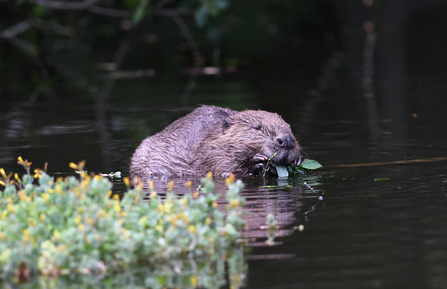
David Parkyn
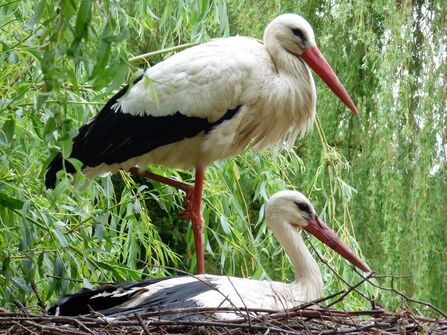
White storks
Photo credit: Derek Gow Consultancy
When will the white storks and beavers arrive at Eastbrookend?
A purpose-built aviary will house the reintroduced white storks, whose chicks will eventually be released to help establish a new breeding population in the area. Construction of the aviary will commence in 2026, with the birds expected on site in autumn 2026. The large nests of storks provide valuable habitats for smaller birds, and their natural feeding behaviours can support ecosystem health.
Beavers are expected to arrive on site in 2027. They will be released into a publicly accessible enclosure featuring two lakes, under licence from Natural England. As renowned ‘ecosystem engineers’, beavers have an extraordinary ability to reshape their surroundings. Their activity encourages the growth of wetland plants and provides vital resources for invertebrates, birds, bats, fish and small mammals, while also increasing overall biodiversity and creating new opportunities for waterfowl and other species. Fallen trees introduced by beavers also create natural perching and nesting sites, which are particularly beneficial for kingfishers, offering valuable vantage points for feeding and breeding.
How can people get involved?
An exciting community engagement programme will help Londoners discover, learn about and connect with these iconic native species, while creating opportunities for people to play an active role in their return. Rewilding East London will showcase how nature can recover in an urban environment, inspiring pride, curiosity, and a stronger connection between people and wildlife as beavers and white storks become part of East London’s landscape once again.
There will be many ways for people to get involved, from drop-in events, workshops, talks, and guided walks to volunteering opportunities that support nature recovery across East London. These activities will give Londoners the chance to learn more about the species, celebrate their return, and experience wildlife up close.
People will also be able to take part in practical conservation and citizen science activities, including monitoring beaver activity, helping with habitat restoration, and supporting ecological surveys. By bringing communities and nature together, the project aims to create lasting connections with wildlife and inspire more people to take part in restoring London’s natural environment.
Sam Davenport, Director of Nature Recovery at London Wildlife Trust, said:
“Reintroducing iconic flagship species like white storks and beavers helps us all to imagine an ambitious future for nature recovery in the capital. It will inspire communities to connect with nature and landowners to create more wetland habitats, in turn, benefiting other species. In this way, the reintroduction of white storks and beavers becomes a catalyst for wider ecological restoration, helping to build a greener, more resilient London for generations to come.”
Councillor Dominic Twomey, Leader of Barking and Dagenham Council, said:
“Securing £500,000 from the Mayor of London’s Green Roots Fund is a testament to the strength of our partnership with London Wildlife Trust and our shared ambition to restore nature at scale. This is a brilliant achievement for our borough and a real win for our residents. The return of beavers and the reintroduction of white storks to Eastbrookend Country Park will transform how people experience nature in Barking and Dagenham. It’s about more than wildlife — it’s about giving families, schools, and community groups the chance to be part of something inspiring and hopeful. I’m proud that we’re leading the way in London, showing how urban spaces can be places of restoration, learning and connection.”
Councillor Saima Ashraf, Cabinet Member for Community Leadership and Engagement at Barking and Dagenham Council, added:
“Eastbrookend Country Park has always been one of our borough’s greatest natural assets and this new funding marks an exciting step forward in the ongoing work to restore and rewild it for future generations. Our fantastic Ranger Service will play a key role in making this vision a reality - supporting habitat creation, engaging the public, and helping these iconic species thrive.”
Mete Coban, Deputy Mayor for Environment and Energy said:
“It’s a privilege to be able to support ambitious wildlife projects like “Rewilding East London”. Reintroducing white storks and beavers to the capital complements our work to transform neighbourhoods and improve London’s green and blue spaces. Access to nature is a social justice issue and we want to ensure all Londoners can experience the brilliant green spaces and wildlife in this city, as we build a better, greener, and fairer London for everyone.”
Rewilding East London FAQs
Why reintroduce white storks?
White storks were once part of Britain’s fauna became extinct as breeding birds due to a combination of overhunting and habitat loss in historic times. For centuries, white storks have been woven into folklore as symbols of renewal, good fortune, and the changing of the seasons. As a result, the highly successful reintroduction project that began at the Knepp Castle Estate in 2018 has received huge public support.
White storks are part of Britain’s rich ecological and cultural history; the village of Storrington in Sussex appears in the Domesday Book in 1086 as "Estorchestone" and was known in 1185 as Storketon and in 1242 as Storgeton. The name which later changed again in into Old English ‘Storca-tun’ has been interpreted as meaning "homestead with storks". Records of other possible breeding sites elsewhere, bone finds, their provision for feasts and hunting records well into modern times demonstrate the species' former occurrence.
At London Wildlife Trust, our vision is for a London alive with wildlife and nature on everyone’s doorstep. Reintroducing an iconic flagship species like white stork helps us all to imagine a more hopeful future for nature recovery in the UK’s capital city. It will inspire communities to connect with nature and landowners to create more wetland habitats for storks, in turn, benefiting other species. In this way, the reintroduction of white storks becomes a catalyst for wider ecological restoration, helping to build a greener, more resilient London for generations to come.
Learn more about the project origins, rationale and methodology
Where are the storks coming from and where will you release them to?
It is not possible to wild release storks in the UK and although the population at Knepp is growing slowly, our project will secure the future of the species in an urban environment. White storks have always lived alongside people, and it is our intention to raise a population of chicks which having been hatched in London will consider it to be their home in a purpose-built aviary at Eastbrookend Country Park. It will be these individuals which will have an innate desire to return to where they hatched after each annual migration, and after several years this will lead to a wild breeding population in East London. The birds will come from established captive breeding programs and will be fully health screened before being released.
Eastbrookend Country Park provides suitable to support white storks, providing the quality habitats needed for the birds to forage in; the wider landscape also offers other rich feeding grounds for the birds nearby, and in time we expect storks to be regularly seen in neighbouring areas of London.
How will you care for the storks and make sure they are safe in their new home?
The birds will be moved to Eastbrookend Country Park under the care of vets and an expert team from Derek Gow Consultancy who have advised on the successful white stork reintroduction at Knepp in Sussex. We will reintroduce the birds into a large purpose-built aviary that includes areas of their preferred grassland habitat. Staff at London Wildlife Trust and London Borough of Barking and Dagenham will feed and check the welfare of the birds daily and conduct regular inspections of their enclosure.
Why are beavers important? Why reintroduce them?
Eurasian beavers are large herbivorous rodents that are native to Britain, having roamed our waterways for millennia before being driven to extinction by human persecution probably around the 1600s. Beavers are now being carefully reintroduced across Britain to help restore wetland habitats, manage water naturally, and support urban biodiversity.
Beavers are known as “ecosystem engineers” because they can dramatically shape the places where they live and provide a wide range of ecological and economic benefits. By creating wetlands, they form rich, dynamic habitats that support a wide variety of plants and animals, boosting overall biodiversity, as well as improving water quality and sequestering carbon.
The landscape at Eastbrookend Country Park has been identified as suitable for beavers, comprising a mix of planted woodland, naturally established willow growing along the edges of the two main lakes, and open areas of grassland and scrub. The shoreline of the lakes, where the sunlight allows, are well vegetated offering plenty of food and good-quality habitat for beavers to forage and move around safely.
Will the beavers be roaming freely?
No – beaver reintroductions in London are currently enclosed due to licensing restrictions, safety, landownership, and infrastructure considerations. The reintroduction process involves stakeholder engagement and landowner support under Natural England’s licensing system.
Until February 2025, beavers were only allowed to be released into enclosures. Years of campaigning and their official recognition as a native species, in 2022, has made it possible to release beaver into the wild, subject to the relevant Natural England licensing requirements.
At Eastbrookend Country Park, the beavers will live within a 12 hectare fenced enclosure encompassing two large fishing lakes and several small islands. Both lakes are artificial, the result of historical gravel extraction which was first started in the 1920s to build the Becontree Estate. There is a network of public footpaths surrounding the lakes, that will remain accessible through self-closing gates, which have successfully kept the beavers safe in other similar projects such as the National Trust at Valewood in Sussex and the Ealing Beaver Project in London.
How will the beavers affect the surrounding environment? Will they cause flooding / damage?
Beavers have the ability to transform their environments and landscapes by coppicing vegetation, foraging, and constructing dams. Beavers instinctively build dams in flowing watercourses to create deeper pools for safety and food access.
However, in stillwater environments such as the front lakes at Eastbrookend Country Park, where there is no inflow or outflow (the lakes are ground water fed, with no direct hydrological links to the surrounding landscape), beavers have no ecological incentive to build dams. Instead, we’ll witness the beaver increase the deadwood, reshape the banks of the lakes and lower the tall willow trees, opening up space and light for smaller plants that grow under and around the trees.
London Wildlife Trust and the Ranger Team from London Borough of Barking and Dagenham are working together, with the support of experts at the Beaver Trust and Derek Gow Consultancy to carry out full risk assessments. This includes checking if any mitigation work might be needed, such as managing or protecting trees, or dealing with burrows that could affect paths.
How will you monitor the beavers and the wider environment?
The field signs of beavers are obvious and easy to define – felled trees, regularly used paths emanating from a water body into the surrounding landscape, wood chips and tracks. A regular maintenance regime will be established to ensure that the enclosure and its fence lines are checked regularly by site staff and trained volunteers to look for signs of burrowing or undermining either inside or outside of the fence line.
Beavers in the enclosures will mainly be monitored using remote trail cameras to check which animals are present, whether they are reproducing, and their overall behaviour, health and welfare.
Beyond monitoring beaver health and welfare, the project team and volunteers will assess the ecological impact on the lakes, including water quality sampling and macrophyte surveys, before and after beaver release. Eastbrookend Country Park has a well-established set of ecological records that can be used to chart a process of change.
Where are the beavers coming from?
The beavers will be sourced and translocated to the site under the project licence in agreement with Natural England and following animal sourcing recommendations and guidelines by The Beaver Trust. The Beaver Trust will facilitate the transfer of the beavers to the site.
Will it be possible to see the beavers?
Beavers are crepuscular, which means that they are most active around dawn and dusk though they may be seen earlier during the summer months. Visitors will be encouraged to observe beavers safely, by watching from a distance, staying quiet and still to minimise disturbance and keeping dogs under control.
Want to find out more about the project or stay updated?
We’ll be sharing updates, news, and future opportunities through our website, social media, and newsletter. Follow us to stay informed and be among the first to hear about the project as it develops! If your query hasn't been answered in the FAQs, please get in touch via our enquiries form.
